This week has focused on the biological aspects of motivation and emotion. The first part of the lecture and chapter three of the text book looked at the physiological motivated brain. The aim of physiological motivational research is to:
1) Figure out what brain structure is associated with different emotional or motivational experiences
2) Find out how these specific brain structures become activated when engaged in a particular motivational or emotional state and
3) Answer how instances in everyday life activate this ongoing process within the brain (Reeve, 2009).
Research in these three areas have formed three principles which are followed when conducting research on motivation, emotion and the brain. These consist of specific brain structures stimulating a particular motivation, biochemical agents stimulating the receptor sites allowing communication within the body and how everyday life events stimulate these processes into action (Reeve, 2009). Below is a diagram from Reeve (2009) providing an example of how this process occurs when the body is deprived of food.
 |
| (Reeve, 2009) |
Despite learning about the differing areas of the brain and the role they play in motivation and emotion, what I found most interesting were the effects of dopamine release. Dopamine produces positive feelings, not only when engaging in an activity that is positive, but even in expectation of something pleasurable. Reeve (2009) states that the release of dopamine, resulting in an increase of positive emotions,can also improve functioning. The happy feelings one gets from engaging in pleasurable activities resulting from dopamine release allows a person to determine which life events and environments will result in these positive feelings occurring again (Reeve, 2009). This suggests that people seek out environments which are either positive or negative in nature. This could possibly be a subject that I could focus on for my text book topic.
The second half of the lecture and chapter four focused on the physiological needs of humans.
“A need is any condition within the person that is essential and necessary for life, growth and well-being” (Reeve, 2009 p. 77)
These were narrowed down to three specific needs, thirst, hunger and sex. I found James' point interesting, he said that humans can not live without food and drink but they can live without sex (Neill, 2010). So is sex really a vital human need? Or does this represent the view that we are put on this earth to procreate? Maslow’s hierarchy of needs was also touched on as these three primary needs are in the physiological category, the group of needs that are the most basic and vital for human survival according to Maslow. For more information on Maslow’s hierarchy of needs here is a link to a website which expands on the theory further. http://psychology.about.com/od/theoriesofpersonality/a/hierarchyneeds.html
Maslow's Hierarchy of Needs Diagram
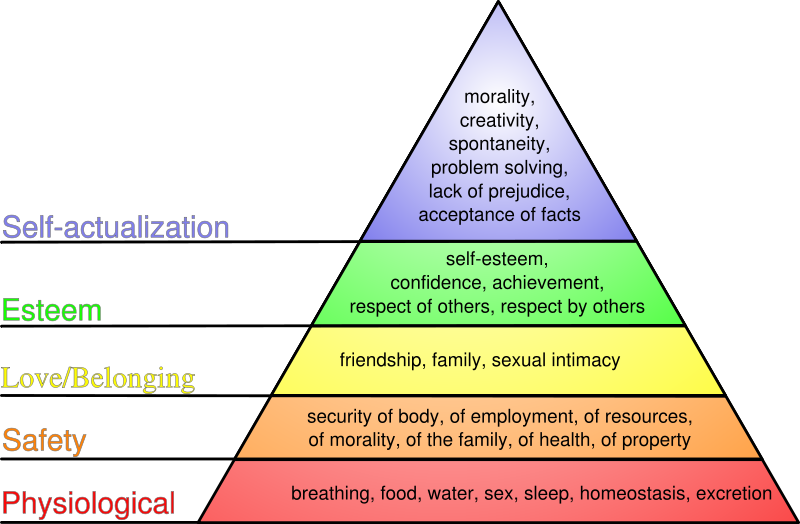
(Cherry, 2010)
The physiological aspects of motivation and emotion were not discussed in tutorials this week. However, we reflected back to week one and were asked to define what motivation and emotion are. When describing motivation, most groups focused on the idea of an internal or external drive which influences an individual to engage in a particular behaviour. Emotion seemed harder to define, however most described it as the feelings that an individual experiences which affect a person’s cognitions and behaviour. For these answers in detail, I have provided the link to the tutorial page. http://en.wikiversity.org/wiki/Motivation_and_emotion/Tutorials/Introduction/Definitions
In tutorials we were also asked to form small groups with whom we will communicate with throughout the semester. The idea behind this is to share and update our group members on our chapter drafts in order to gain continual feedback, improve and expand on what we have done individually. I think this is a good idea as other people come up with ideas you may not have thought of before. It will also be helpful to compare my work to others to see if I am heading in the right direction.
This week we were asked to think of our chosen chapter topic in the form of a question. The first question that came to my mind was “What motivates an individual to think positively?” By taking a new angle on the topic and thinking of questions I would like to answer, it has made me realise that ‘positive thinking’ is a very broad topic, one which could be tackled from various angles. Deciding where I would like to go specifically with this topic and how I will go about completing it will be my new challenge over the next week.
References
*Maslow's Hierarchy of Needs (2010, September 5). In Hierarchy of Needs. Retrieved from http://psychology.about.com/od/theoriesofpersonality/a/hierarchyneeds.htm
*Neill, J. (2010, September 1). [Brain and Physiological Needs Lecture] Lecture presented at the University of Canberra, ACT. [Lecture notes]. Retrieved from http://learnonline.canberra.edu.au/course/view.php?id=4208
*Reeve, J. (2009). Understanding motivation and emotion. United States of America, USA: John Wiley & Sons, Inc.

